
CCNA1 v6.0 Chapter 5 Exam 2018
Chapter 5: Ethernet
The OSI physical layer provides the means to transport the bits that make up a data link layer frame across the network media.
Ethernet is now the predominant LAN technology in the world. Ethernet operates in the data link layer and the physical layer. The Ethernet protocol standards define many aspects of network communication including frame format, frame size, timing, and encoding. When messages are sent between hosts on an Ethernet network, the hosts format the messages into the frame layout that is specified by the standards.
Because Ethernet is comprised of standards at these lower layers, it may best be understood in reference to the OSI model. The OSI model separates the data link layer functionalities of addressing, framing, and accessing the media from the physical layer standards of the media. Ethernet standards define both the Layer 2 protocols and the Layer 1 technologies. Although Ethernet specifications support different media, bandwidths, and other Layer 1 and 2 variations, the basic frame format and address scheme is the same for all varieties of Ethernet.
This chapter examines the characteristics and operation of Ethernet as it has evolved from a shared media, contention-based data communications technology to today’s high bandwidth, full-duplex technology.
Leaderboard: CCNA1 v6.0 Chapter 5 Exam
| Pos. | Name | Entered on | Points | Result |
|---|---|---|---|---|
| Table is loading | ||||
| No data available | ||||
Quiz-summary
0 of 22 questions completed
Questions:
- 1
- 2
- 3
- 4
- 5
- 6
- 7
- 8
- 9
- 10
- 11
- 12
- 13
- 14
- 15
- 16
- 17
- 18
- 19
- 20
- 21
- 22
Information
CCNA1 v6.0 Chapter 5 Exam
You have already completed the quiz before. Hence you can not start it again.
Quiz is loading...
You must sign in or sign up to start the quiz.
You have to finish following quiz, to start this quiz:
Results
0 of 22 questions answered correctly
Your time:
Time has elapsed
You have reached 0 of 0 points, (0)
| Average score |
|
| Your score |
|
Categories
- Not categorized 0%
- 1
- 2
- 3
- 4
- 5
- 6
- 7
- 8
- 9
- 10
- 11
- 12
- 13
- 14
- 15
- 16
- 17
- 18
- 19
- 20
- 21
- 22
- Answered
- Review
-
Question 1 of 22
1. Question
1 pointsWhat happens to runt frames received by a Cisco Ethernet switch?
Correct
Incorrect
-
Question 2 of 22
2. Question
2 pointsWhat are the two sizes (minimum and maximum) of an Ethernet frame? (Choose two.)
Correct
Incorrect
-
Question 3 of 22
3. Question
1 pointsWhat statement describes Ethernet?
Correct
Incorrect
-
Question 4 of 22
4. Question
2 pointsWhich two statements describe features or functions of the logical link control sublayer in Ethernet standards? (Choose two.)
Correct
Incorrect
-
Question 5 of 22
5. Question
1 pointsWhat statement describes a characteristic of MAC addresses?
Correct
Incorrect
-
Question 6 of 22
6. Question
1 pointsWhich statement is true about MAC addresses?
Correct
Incorrect
-
Question 7 of 22
7. Question
1 pointsWhich destination address is used in an ARP request frame?
Correct
Incorrect
-
Question 8 of 22
8. Question
1 pointsWhat addressing information is recorded by a switch to build its MAC address table?
Correct
Incorrect
-
Question 9 of 22
9. Question
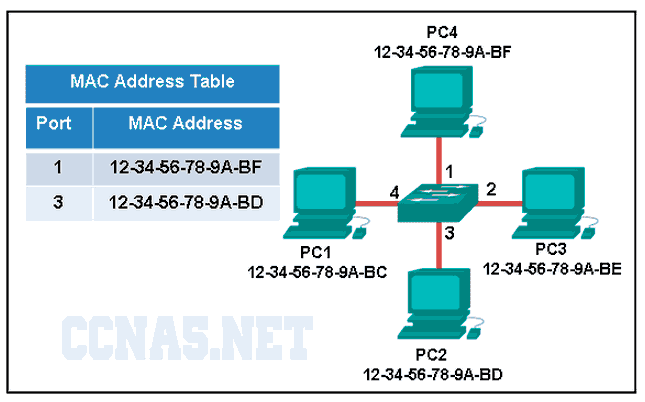
1 pointsRefer to the exhibit. The exhibit shows a small switched network and the contents of the MAC address table of the switch. PC1 has sent a frame addressed to PC3. What will the switch do with the frame?
 Correct
Incorrect
-
Question 10 of 22
10. Question
1 pointsWhich switching method uses the CRC value in a frame?
Correct
Incorrect
-
Question 11 of 22
11. Question
1 pointsWhat is auto-MDIX?
Correct
Incorrect
-
Question 12 of 22
12. Question
1 pointsTrue or False?
When a device is sending data to another device on a remote network, the Ethernet frame is sent to the MAC address of the default gateway.
Correct
Incorrect
-
Question 13 of 22
13. Question
1 pointsThe ARP table in a switch maps which two types of address together?
Correct
Incorrect
-
Question 14 of 22
14. Question
1 pointsRefer to the exhibit. PC1 issues an ARP request because it needs to send a packet to PC2. In this scenario, what will happen next?
 Correct
Incorrect
-
Question 15 of 22
15. Question
1 pointsRefer to the exhibit. A switch with a default configuration connects four hosts. The ARP table for host A is shown. What happens when host A wants to send an IP packet to host D?
Correct
Incorrect
-
Question 16 of 22
16. Question
1 pointsRefer to the exhibit. The switches are in their default configuration. Host A needs to communicate with host D, but host A does not have the MAC address for its default gateway. Which network hosts will receive the ARP request sent by host A?
Correct
Incorrect
-
Question 17 of 22
17. Question
1 pointsWhich statement describes the treatment of ARP requests on the local link?
Correct
Incorrect
-
Question 18 of 22
18. Question
2 pointsWhat are two potential network problems that can result from ARP operation? (Choose two.)
Correct
Incorrect
-
Question 19 of 22
19. Question
1 pointsFill in the blank.
- A collision fragment, also known as a (RUNT, runt) frame, is a frame of fewer than 64 bytes in length.
Correct
Incorrect
-
Question 20 of 22
20. Question
1 pointsFill in the blank.
- On a Cisco switch, (port-based) memory buffering is used to buffer frames in queues linked to specific incoming and outgoing ports.
Correct
Incorrect
-
Question 21 of 22
21. Question
1 pointsFill in the blank.
- ARP (spoofing) is a technique that is used to send fake ARP messages to other hosts in the LAN. The aim is to associate IP addresses to the wrong MAC addresses.
Correct
Incorrect
-
Question 22 of 22
22. Question
6 pointsMatch the characteristic to the forwarding method. (Not all options are used.)
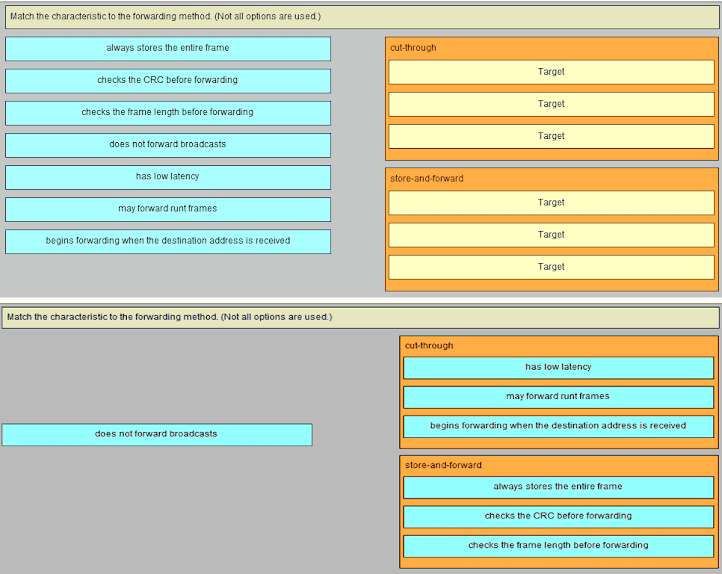
Sort elements
- low latency (A)
- may forward runt frames (B)
- begins forwarding when the destination address is received (C)
- always stores the entire frame (D)
- checks the CRC before forwarding (E)
- checks the frame length before forwarding (F)
-
cut-through (A)
-
cut-through (B)
-
cut-through (C)
-
store-and-forward (D)
-
store-and-forward (E)
-
store-and-forward (F)
Correct
Incorrect

